<?xml version="1.0" encoding="utf-8" ?>
<rdf:RDF xmlns:rdf="http://www.w3.org/1999/02/22-rdf-syntax-ns#" xmlns:dc="http://purl.org/dc/elements/1.1/" xmlns:syn="http://purl.org/rss/1.0/modules/syndication/" xmlns="http://purl.org/rss/1.0/">


<channel rdf:about="https://old.dmi.unife.it/en/search_rss">
  <title>Department of Mathematics and Computer Science</title>
  <link>https://old.dmi.unife.it</link>

  <description>
    
            These are the search results for the query, showing results 1 to 4.
        
  </description>


  <image rdf:resource="https://old.dmi.unife.it/logo.png"/>

  <items>
    <rdf:Seq>
      
        <rdf:li rdf:resource="https://old.dmi.unife.it/en/highlights/uncertainty-quantification-and-the-boltzmann-legacy"/>
      
      
        <rdf:li rdf:resource="https://old.dmi.unife.it/en/highlights/on-coarser-interval-temporal-logics"/>
      
      
        <rdf:li rdf:resource="https://old.dmi.unife.it/en/highlights/combining-logic-and-probability"/>
      
      
        <rdf:li rdf:resource="https://old.dmi.unife.it/en/highlights/a-brief-history-of-mathematics-at-the-university-of-ferrara"/>
      
    </rdf:Seq>
  </items>

</channel>


  <item rdf:about="https://old.dmi.unife.it/en/highlights/uncertainty-quantification-and-the-boltzmann-legacy">
    <title>Uncertainty quantification and the Boltzmann legacy</title>
    <link>https://old.dmi.unife.it/en/highlights/uncertainty-quantification-and-the-boltzmann-legacy</link>
    <description>After the celebrated Boltzmann equation in 1872, which describes the time evolution of a rarefied gas, kinetic equations have been applied to model a variety of phenomena whose multiscale nature cannot be described by a standard macroscopic approach.</description>
    <content:encoded xmlns:content="http://purl.org/rss/1.0/modules/content/"><![CDATA[<p><span id="docs-internal-guid-91db9451-34fa-eded-39f8-b7f883d2d164"> </span></p>
<p dir="ltr"><span style="text-align: justify; ">The equation arises not by analyzing the individual positions and velocity of each </span><span style="text-align: justify; ">particle</span><span style="text-align: justify; "> in the fluid but by considering a probability distribution </span><span style="text-align: justify; ">f</span><span style="text-align: justify; ">(</span><span style="text-align: justify; ">x</span><span style="text-align: justify; ">,</span><span style="text-align: justify; ">v</span><span style="text-align: justify; ">,</span><span style="text-align: justify; ">t</span><span style="text-align: justify; ">) for the position and velocity of a typical particle—that is, the probability that the particle occupies a given very small region of space centered at the position </span><span style="text-align: justify; ">x</span><span style="text-align: justify; ">, and has velocity nearly equal to </span><span style="text-align: justify; ">v</span><span style="text-align: justify; "> (thus occupying a very small region of velocity space), at an instant of time </span><span style="text-align: justify; ">t</span><span style="text-align: justify; ">.</span></p>
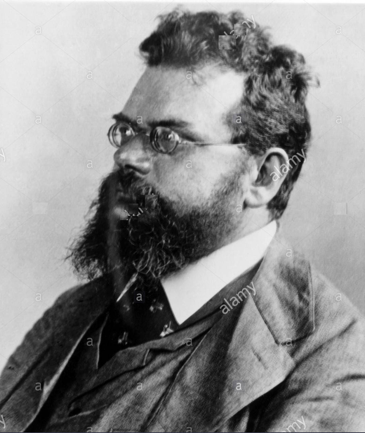
<p dir="ltr"><span style="text-align: justify; "> </span><img style="text-align: justify; " height="189" src="https://lh6.googleusercontent.com/Uj99k07SdwxDwo91o_cYXdbUSBxerpi4p3OToHwewBcyM_Zj1qpwSErXuzyHipbN1djV5pmLhhJJGwt1ROdkgcQVe383zHm9wYlZ0LvnaZu4F5p7ZX6cW8s6pBRIkbPghhLUuacidgH6ATs_dw" width="159" /></p>
<p><i><span>Ludwig Boltzmann (1844-1906)</span></i></p>
<p dir="ltr" style="text-align: justify; "> </p>
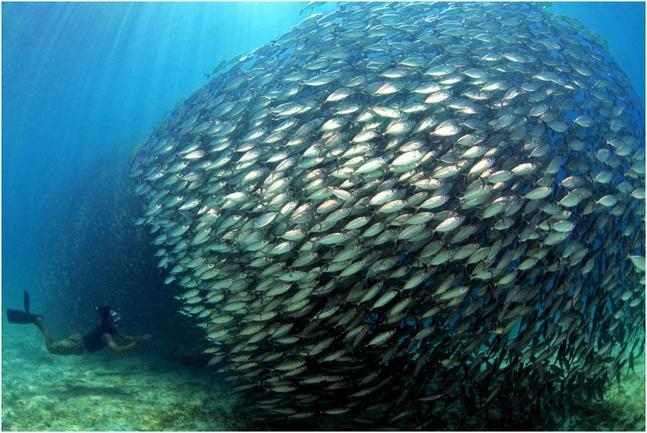
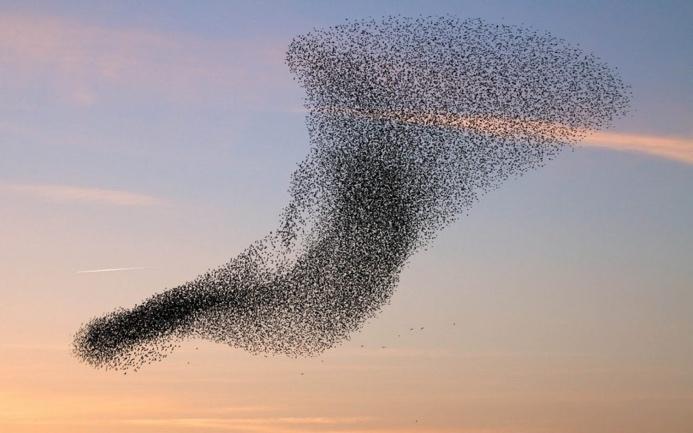
<p dir="ltr" style="text-align: justify; "><span>Recently, kinetic equations have found novel applications in the study of emergent behaviors in complex systems characterized by the spontaneous formation of spatio-temporal structures as a result of simple local interactions between agents. These include the study of birds’ flocks, insects’ swarming, crowd dynamics, opinions’ formation, stock markets and wealth distributions. Clearly, the basic entities in these fields differ from physical particles in that they already have an intermediate complexity themselves and are commonly denoted as </span><span>agents</span><span> (see [6]).</span></p>
<p dir="ltr" style="text-align: justify; "><span> </span><img height="189" src="https://lh4.googleusercontent.com/qkj9e7POkje2CzfSJCevUIQMk04TBPUTII_FtTj3qWzMBPvgt0kAIKYiZJqW61wOPXh2CvLHjd-tdoZi1mXHUY7NcYdO84DiKo9x0VUkPS4uh21wDe2OzbeUpJJr8lS3q0ur5Vl6OltqBBMpCw" width="282" /><img height="189" src="https://lh6.googleusercontent.com/ReHRg0NmXsqgiTZWvP-jOkRaDq9fQwR_jPRQ8IRy-fP5KzKox-gzZg-JMyNfWS6pTj8Bm7t-sP7FbCj2Ig5oJ_JAXoV3RS3sOClVaj1ggmBNLweWo9PJwNszIp83icqB0LxDQA1mOPDDkBLRyQ" width="302" /></p>
<p><i><span>Milling behavior in fishes (left) and flocking of starlings (right) </span></i></p>
<p dir="ltr" style="text-align: justify; "> </p>
<p dir="ltr" style="text-align: justify; "><span>One of the major difficulties in applying the classical toolbox of kinetic theory to these new fields is the lack of fundamental principles which define the microscopic dynamic. A degree of uncertainty is therefore implicitly embedded in such models, since most modeling parameters can be assigned only as statistical information from experimental results (see [4] for recent surveys).</span></p>
<p> </p>
<p dir="ltr" style="text-align: justify; "><span>In spite of the vast amount of existing research, both theoretically and numerically (see [3,8]), the study of kinetic equations has mostly remained deterministic and ignored </span><span>uncertainty</span><span>. In reality, there are many sources of uncertainties that can arise in these equations:</span></p>
<p> </p>
<ul>
<li dir="ltr" style="list-style-type: disc; ">
<p dir="ltr" style="text-align: justify; "><span>Incomplete knowledge of the interaction mechanism between particles/agents.</span></p>
</li>
<li dir="ltr" style="list-style-type: disc; ">
<p dir="ltr" style="text-align: justify; "><span>Imprecise measurements of the initial and boundary data.</span></p>
</li>
<li dir="ltr" style="list-style-type: disc; ">
<p dir="ltr" style="text-align: justify; "><span>Other sources of uncertainty like forcing and geometry, etc. </span></p>
</li>
</ul>
<p> </p>
<p dir="ltr" style="text-align: justify; "><span>Understanding the impact of these uncertainties is critical to the simulations of the complex kinetic systems to validate the kinetic models, and will allow scientists and engineers to obtain more reliable predictions and perform better risk assessment.</span></p>
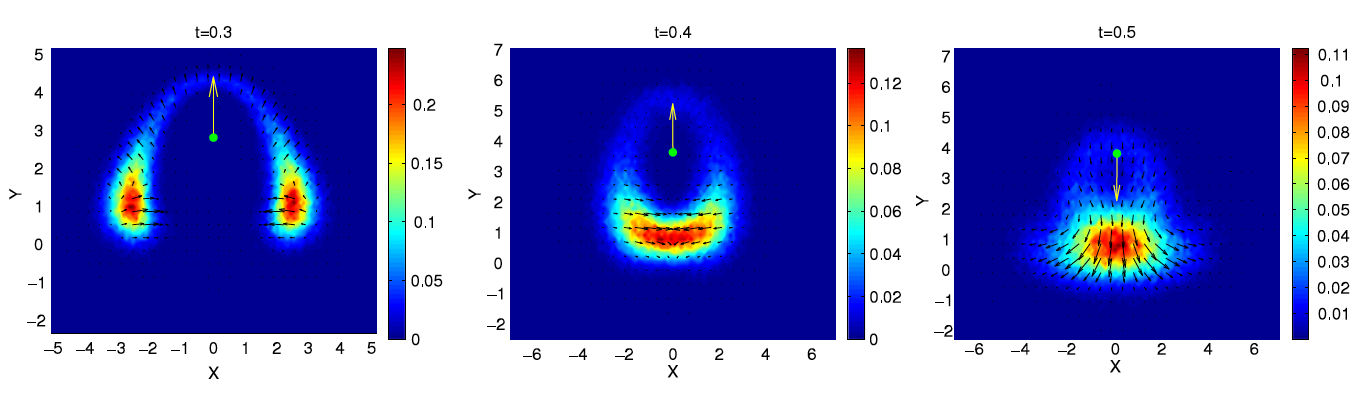
<p dir="ltr" style="text-align: justify; "><span><img height="185" src="https://lh6.googleusercontent.com/BhpXOqa7zdOiaj7tu_fcbybqgOFfpsHg0PpMHW9pIwWR90s-YlWwH2oeCTAEFzrGQw9L4Lgd7CRA4kmw_pUm5EyQUhmw6LbdQilktRplrxwb0yoeKyfrmro5y44_g0eHGix-bm5V5vBZ0wt-JA" width="642" /></span></p>
<p dir="ltr" style="text-align: justify; "><i><span>Simulation of a flock attacked by a predator using the method developed in [1] </span></i></p>
<p dir="ltr" style="text-align: justify; "> </p>
<p dir="ltr" style="text-align: justify; "><span>The development of numerical methods for kinetic equations presents several difficulties due to the high dimensionality and the intrinsic structural properties of the solution. Non-negativity of the distribution function, conservation of invariant quantities, entropy dissipation and steady states are essential in order to compute qualitatively correct solutions. Preservation of these structural properties is even more challenging in presence of uncertainties which contribute to </span><span>curse of dimensionality</span><span>.</span></p>
<p> </p>
<p dir="ltr" style="text-align: justify; "><span>Uncertainty quantification (UQ) in kinetic equations represents a computational challenge for many reasons. Simple UQ tasks such as the estimation of statistical properties of the solution typically require multiple calls to a deterministic solver. A single solver call is already very expensive for such complex mathematical models. </span></p>
<p> </p>
<p dir="ltr" style="text-align: center; "><span><img height="189" src="https://lh3.googleusercontent.com/lKZaHycgPgrRCFoljhcxUCcQ9Ai2c1yjQ_sAahlJNqIT8IL5KM8t9ZrArVqucBksotGrsf6zS454UrswQidUu8vyAL8khIg9QnF1ZGG9-jZKA8qWa6n6wuH38nFfFXEO3tD_ZJMnbNWxnwGjCw" width="386" /></span></p>
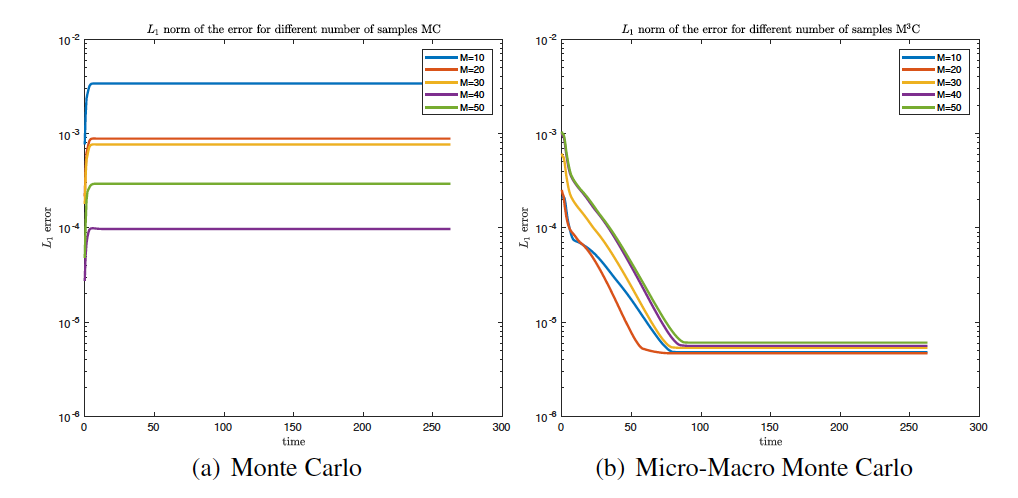
<p dir="ltr" style="text-align: center; "><i><span>Convergence acceleration of Micro-Macro Monte Carlo versus standard Monte Carlo</span></i></p>
<p dir="ltr" style="text-align: justify; "> </p>
<p dir="ltr" style="text-align: justify; "><span>Researchers at DMCS have a recognized international experience in the numerical analysis of kinetic equations with fundamental contributions in the development of fast spectral methods, Monte Carlo methods and asymptotic preserving schemes (see the recent review in [3] for example).  Recently they developed novel approaches to UQ of kinetic equations based on generalized Polynomial Chaos expansions at a particle level in order to reduce the problem dimension and maintain the main physical properties of the solution (see [2]) and on micro-macro Monte Carlo techniques which using control variate estimators based on the local equilibrium are capable to accelerate the slow statistical convergence of Monte Carlo methods (see [4, Chapter 5]). </span></p>
<p> </p>
<p dir="ltr"><span>References</span></p>
<ol>
<li dir="ltr" style="list-style-type: decimal; ">
<p dir="ltr" style="text-align: justify; "><span>Albi G., Pareschi L. (2013), </span><span>Binary interaction algorithms for the simulation of flocking and swarming dynamics</span><span>. Multiscale Modeling &amp; Simulation 11, 1-29.</span></p>
</li>
<li dir="ltr" style="list-style-type: decimal; ">
<p dir="ltr" style="text-align: justify; "><span>Carrillo J.A., Pareschi L., Zanella M. (2017), </span><span>Particle gPC methods for mean field models of swarming with uncertainties</span><span>, arXiv:1712.01677. </span></p>
</li>
<li dir="ltr" style="list-style-type: decimal; ">
<p dir="ltr" style="text-align: justify; "><span>Dimarco G., Pareschi L. (2015), </span><span>Numerical methods for kinetic equations</span><span>. Acta Numerica.</span></p>
</li>
<li dir="ltr" style="list-style-type: decimal; ">
<p dir="ltr" style="text-align: justify; "><span>Jin S., Pareschi L., eds (2018), Uncertainty quantification in hyperbolic and kinetic equations</span><span>. SEMA-SIMAI Series in Applied Mathematics,</span><span> Springer.</span></p>
</li>
<li dir="ltr" style="list-style-type: decimal; ">
<p dir="ltr" style="text-align: justify; "><span>Mouhot C., Pareschi L. (2006), </span><span>Fast algorithms for computing the Boltzmann collision operator</span><span>. Mathematics of Computation 75, 1833-1852.</span></p>
</li>
<li dir="ltr" style="list-style-type: decimal; ">
<p dir="ltr" style="text-align: justify; "><span>Pareschi L., Toscani G. (2013), Interacting multi-agents systems: kinetic equations and Monte Carlo methods. </span><span>Oxford University Press</span><span>, (2013)</span></p>
</li>
<li dir="ltr" style="list-style-type: decimal; ">
<p dir="ltr" style="text-align: justify; "><span>Pareschi L., Toscani G., Villani C. (2003), </span><span>Spectral methods for the non cut-off Boltzmann equation and numerical grazing collision limit</span><span>. Numerische Mathematik 93, 527-548.</span></p>
</li>
<li dir="ltr" style="list-style-type: decimal; ">
<p dir="ltr" style="text-align: justify; "><span>Villani C. (2002), A survey of mathematical topics in kinetic theory. </span><span>Handbook of fluid mechanics</span><span>, S. Friedlander and D. Serre, Eds. Elsevier Publ. North-Holland vol. I, 71-305.</span></p>
</li>
</ol>
<p> </p>
<p dir="ltr"><span>Contact</span></p>
<p dir="ltr"><span>Prof. Lorenzo Pareschi</span></p>
<p dir="ltr"><span>Department of Mathematics and Computer Science</span></p>
<p dir="ltr"><span>University of Ferrara</span></p>
<p dir="ltr"><span>Via Machiavelli 30, 44121 Ferrara</span></p>
<p dir="ltr"><span>e-mail: </span><a href="mailto:lorenzo.pareschi@unife.it"><span>lorenzo.pareschi@unife.it</span></a></p>
<p><span>web: </span><a href="http://www.lorenzopareschi.com"><span>www.lorenzopareschi.com</span></a></p>]]></content:encoded>
    <dc:publisher>No publisher</dc:publisher>
    <dc:creator>Ferrari Michele</dc:creator>
    <dc:rights></dc:rights>
    
      <dc:subject>highlights</dc:subject>
    
    <dc:date>2018-12-05T14:46:51Z</dc:date>
    <dc:type>News Item</dc:type>
  </item>


  <item rdf:about="https://old.dmi.unife.it/en/highlights/on-coarser-interval-temporal-logics">
    <title>On coarser interval temporal logics</title>
    <link>https://old.dmi.unife.it/en/highlights/on-coarser-interval-temporal-logics</link>
    <description>The primary characteristic of interval temporal logic is that intervals, rather than points, are taken as the primitive ontological entities. Given their generally bad computational behavior of interval temporal logics, several techniques exist to produce decidable and computationally affordable temporal logics based on intervals. </description>
    <content:encoded xmlns:content="http://purl.org/rss/1.0/modules/content/"><![CDATA[<p>In this  paper we take inspiration from Golumbic and Shamir's coarser interval  algebras, which generalize the classical Allen's Interval Algebra, in  order to define two previously unknown variants of Halpern and Shoham's  logic (HS) based on coarser relations. We prove that, perhaps  surprisingly, the satisfiability problem for the coarsest of the two  variants, namely <span class="math"><span class="MathJax_Preview"> </span><span class="MathJax_SVG" id="MathJax-Element-1-Frame"> </span></span><span class="math"> </span>, not only is decidable, but <span class="small-caps">PSpace</span>-complete in the finite/discrete case, and <span class="small-caps">PSpace</span>-hard  in any other case; besides proving its complexity bounds, we implement a  tableau-based satisfiability checker for it and test it against a  systematically generated benchmark. Our results are strengthened by  showing that not all coarser-than-Allen's relations are a guarantee of  decidability, as we prove that the second variant, namely <span class="math"><span class="MathJax_Preview"> </span><span class="MathJax_SVG" id="MathJax-Element-2-Frame"> </span></span><span class="math"> </span>, remains undecidable in all interesting cases.</p>
<p><i><b>The article is avaible in full version at this link: <a class="external-link" href="https://www.sciencedirect.com/science/article/pii/S0004370218305964#br0050">https://www.sciencedirect.com/science/article/pii/S0004370218305964#br0050</a></b></i></p>
<div class="Keywords">
<div class="keywords-section" id="kws0010">
<h2 class="section-title"></h2>
<p class="section-title"><img src="https://old.dmi.unife.it/en/highlights/results.JPG" alt="results" class="image-left" title="results" /></p>
<p class="section-title"> </p>
<p class="section-title"><b>Keywords</b></p>
<div class="keyword" id="kw0030"><span>Modal and temporal logic; (Un)Decidability; Complexity   <br /></span></div>
<div class="keyword"></div>
<div class="keyword">
<p> </p>
<p><b>Authors</b></p>
<ul>
<li><b><span class="workspace-trigger size-m author"><span class="content"><span class="given-name text">Emilio</span><span class="surname text">Muñoz-Velasco - </span></span></span></b> Department of Applied Mathematics, University of Malaga, Spain</li>
<li><b><span class="workspace-trigger size-m author"><span class="content"><span class="author-ref" id="baff0010"> </span></span></span><span class="workspace-trigger size-m author"><span class="content"><span class="given-name text">Mercedes</span><span class="surname text">Pelegrín - </span></span></span></b>Department of Statistics and Operational Research, University of Murcia, Spain</li>
<li><b><span class="workspace-trigger size-m author"><span class="content"><span class="given-name text">Pietro</span><span class="surname text">Sala -</span></span></span></b> Department of Computer Science, University of Verona, Italy</li>
<li><b><b><span class="workspace-trigger size-m author"><span class="content"><span class="given-name text">Guido</span><span class="surname text"> Sciavicco</span></span></span></b> - Department of Mathematics and Computer Science, University of Ferrara, Italy</b></li>
<li><b><span class="workspace-trigger size-m author"><span class="content"><span class="given-name text">Ionel Eduard</span><span class="surname text">Stan - </span></span></span></b>Department of Mathematics, Computer Science, and Physics, University of Udine, Italy</li>
</ul>
<p> </p>
<p>Received 16 April 2017, Revised 7 September 2018, Accepted 20 September 2018, Available online 17 October 2018 on</p>
<div class="publication-volume u-text-center">
<h2 class="publication-title" id="publication-title"><a class="publication-title-link external-link" href="https://www.sciencedirect.com/science/journal/00043702" target="_blank">Artificial Intelligence</a></h2>
<div class="text-xs"><a href="https://www.sciencedirect.com/science/journal/00043702/266/supp/C" title="Go to table of contents for this volume/issue">Volume 266</a>, January 2019, Pages 1-26</div>
<div class="text-xs"></div>
<div class="text-xs">
<div id="gt-input-tool">
<div><span class="ita-kd-inputtools-div"> </span></div>
</div>
<br /> <i><span id="result_box"><span title="'Artificial Intelligence', rivista che ha iniziato ad essere pubblicata nel 1970, ed oggi generalmente considerata la rivista principale nel mondo per l'intelligenza artificiale, soprattutto per quanto riguarda aspetti teorici e fondazionali (fattore di impatto di 3.034, fattore di impatto a 5"><b>Artificial  Intelligence</b> is a magazine that began to be published in 1970, and is  now generally considered the world's leading magazine for artificial  intelligence, especially as regards theoretical and foundational aspects  (impact factor of 3.034, impact factor at 5 </span><span title="anni 4.156).&amp;#xA;">years 4.156).<br /></span><span title="Pubblicazione DMI su &quot;Artificial Intelligence&quot;&amp;#xA;&amp;#xA;"><br /></span><span title="Il professor Guido Sciavicco, in collaborazione con tre ricercatori italiani e spagnoli, e con un ex-studente del corso di Laurea in Informatica della nostra università, ha firmato un articolo che apparirà nella primavera del prossimo anno, riguardante aspetti di computabilità e di complessità di">Professor  Guido Sciavicco, in collaboration with three Italian and Spanish  researchers, and a graduate in Computer Science  of our university, has signed this article. It concerns aspects of computability and complexity of </span><span title="logiche temporali intervallari, da tempo considerate uno strumento di indubbia utilità per la rappresentazione della conoscenza.">Interval periodic logics, long considered an instrument of undoubted utility for the representation of knowledge. </span><span title="Tra altri risultati, in questo lavoro si è dimostrato che utilizzando relazioni temporali imprecise (meno espressive di quelle classiche, ma ancora sufficientemente espressive da avere una valenza pratica), è possibile costruire un linguaggio temporale formale per il quale esiste un algoritmo relativamente efficiente per stabilire">Among  other results, this work has shown that using inaccurate temporal  relations (less expressive than the classical ones, but still  sufficiently expressive to have a practical value), it is possible to  construct a formal temporal language for which there is a relatively  efficient algorithm to establish </span><span title="se una certa affermazione è vera.">if a certain statement is true. </span><span title="Tra gli aspetti più interessanti di questo lavoro, si evidenzia la possibiltà di utilizzare queste relazioni nell'ambito dell'estrazione della conoscenza, in particolare da dati che presentano interazioni complesse tra serie temporali.">Among  the most interesting aspects of this work, we highlight the possibility  of using these relationships in the extraction of knowledge, in  particular from data that present complex interactions between time  series. </span><span title="Gli autori, in ordine alfabetico, sono: Emilio Muñoz-Velasco (Università di Malaga), Mercedes Pelegrìn (Università di Murcia), Pietro Sala (Università di Verona), Guido Sciavicco (Università di Ferrara), e Ionel Eduard Stan (ex-">The  authors, in alphabetical order, are: Emilio Muñoz-Velasco (University  of Malaga), Mercedes Pelegrìn (University of Murcia), Pietro Sala  (University of Verona), Guido Sciavicco (University of Ferrara), and  Ionel Eduard Stan (graduate at</span><span title="studente dell'Univeristà di Ferrara, oggi studente magistrale all'Università di Udine)."> the University of Ferrara, today a master's student at the University of Udine).</span></span></i></div>
<div class="text-xs"></div>
</div>
</div>
<div class="keyword"><span> </span><span> </span></div>
</div>
</div>]]></content:encoded>
    <dc:publisher>No publisher</dc:publisher>
    <dc:creator>Marangon Sara</dc:creator>
    <dc:rights></dc:rights>
    
      <dc:subject>highlights</dc:subject>
    
    <dc:date>2018-11-20T15:35:00Z</dc:date>
    <dc:type>News Item</dc:type>
  </item>


  <item rdf:about="https://old.dmi.unife.it/en/highlights/combining-logic-and-probability">
    <title>Combining Logic and Probability</title>
    <link>https://old.dmi.unife.it/en/highlights/combining-logic-and-probability</link>
    <description>Combining logic and probability is one of the long standing problems of Artificial Intelligence. Logic is very useful for describing domains with many different entities connected by complex relationships, while probability theory deals very well with the uncertainty that is associated to the data we collect from the world.
</description>
    <content:encoded xmlns:content="http://purl.org/rss/1.0/modules/content/"><![CDATA[<p dir="ltr" id="docs-internal-guid-49082222-5a46-c734-4336-c3e04e80ebc1"><span>One of the aims of Artificial Intelligence is to develop machines that can reason on knowledge of the real world and derive information implied by it.</span></p>
<p dir="ltr"><span>However, describing the real world is difficult because it usually includes many entities connected by a wide variety of relationships and the information we collect is often uncertain and incomplete.</span></p>
<p dir="ltr"><span>To deal with the complexity of real world domains, AI researchers have developed powerful methods based on logic, while to deal with uncertainty they have devised clever techniques based on probability theory and statistics.</span></p>
<p dir="ltr"><span>Until recently these two lines of research advanced independently because of the difficulties in combining them. The last twenty years have seen the fast growth of the field of Statistical Relational Artificial Intelligence (StarAI) which aims at overcoming these difficulties.</span></p>
<p dir="ltr"><span>Researchers of DMCS are actively involved in StarAI by developing methods that combine logic programming with probability theory. They developed algorithm for drawing conclusions from probabilistic logic programs (inference) and algorithms that are able to autonomously build descriptions of the world from data (learning).</span></p>
<p dir="ltr"><span>They developed the web application</span></p>
<p dir="ltr"><a href="http://cplint.ml.unife.it/"><span>http://cplint.ml.unife.it/</span></a></p>
<p dir="ltr"><span>where all the algorithms developed by the group can be tried online, even on datasets supplied by the users.</span></p>
<p dir="ltr"><span>Probabilistic Logic Programming (PLP) is a powerful tool that has a large number of applications, from medicine to marketing, social networks, natural language processing, games, biology and genetics.</span></p>
<p dir="ltr"><span>In medicine, it can be used to perform causal reasoning and rigorously identify the effects of treatments, avoiding pitfalls such as the Simpson Paradox, see </span><a href="http://cplint.ml.unife.it/example/inference/simpson.swinb"><span>http://cplint.ml.unife.it/example/inference/simpson.swinb</span></a></p>
<p dir="ltr"><span>In marketing and social networks, we can predict with PLP whether a marketing action such as sending promotional material regarding a product to a number of clients can have a viral effect on the social network of all clients, see</span></p>
<p dir="ltr"><a href="http://cplint.ml.unife.it/example/inference/viral.swinb"><span>http://cplint.ml.unife.it/example/inference/viral.swinb</span></a></p>
<p dir="ltr"><span><br /></span></p>
<table class="plain">
<tbody>
<tr>
<td><img height="305" src="https://lh3.googleusercontent.com/bq56-xJz7xl5A2mllYhQY52mVyDo2zEcGTIsewO66ZZI5cnwFOA6ebrXmlAvt8rStNsZO6mRqLyPJQW-JdWmaSqRKRboq--LAhQkkqWKKxl6QmlVGxnszauaEZvOyc85_mSa7cep" width="166" /></td>
<td>
<p dir="ltr"><span>In social networks, as well as in other kind of   graphs such as biological or telecommunication networks, we can compute   the probability of a connection between two nodes, a problem knwon as   “path reliability”, see </span><a href="http://cplint.ml.unife.it/example/inference/path.swinb"><span>http://cplint.ml.unife.it/example/inference/path.swinb</span></a><span> </span></p>
<p dir="ltr"><span>Or, we can compute the probability of the existence of a link between two individuals</span></p>
<p> </p>
<p> </p>
<p> </p>
<p> </p>
<p> </p>
<p> </p>
<p><a href="http://cplint.ml.unife.it/example/inference/uwcse.pl"><span>http://cplint.ml.unife.it/example/inference/uwcse.pl</span></a></p>
</td>
</tr>
<tr>
<td><img height="204" src="https://lh5.googleusercontent.com/savoyXmuYlPBGZ76AGX8nwCEOHId1DcwU31cYFz4MaiPPc1OVGsel9FhnBUo_OsjkmkILazkSb8-3c0LdnL3nG3nQfbs4b6zmVlSiTrG_5o8-6WcE1cxghC3kfS6uPf4ev16PSKu" width="204" /></td>
<td>
<p dir="ltr"><span>In games, we can exploit PLP for endowing games with  intelligence and variation. For example, we can use it to randomly  generate 2D maps as in </span></p>
<p dir="ltr"><a href="http://cplint.ml.unife.it/example/inference/tile_map.swinb"><span>http://cplint.ml.unife.it/example/inference/tile_map.swinb</span></a></p>
<p><br /><br /><br /><br /><br /><br /><br /><br /></p>
<span>Tiles from </span><a href="https://github.com/silveira/openpixels"><span>https://github.com/silveira/openpixels</span></a></td>
</tr>
<tr>
<td><img height="299" src="https://lh5.googleusercontent.com/Blg2V1LEJPICoFSMpNFHe8Bf9sWhOYBteTCSWJoDiTTHVB-R_m7MddGnTM66qUg2pxFMmob7vup4j8f9-ggo3nds25RijsOjX0qTAxQwNTIPQDeVVJi816a3kvvizetgycgynDX-" width="225" /></td>
<td>
<p dir="ltr"><span>In biology, it can be used to predict whether a  molecule can cause cancer by looking at the chemical structure of the  formula. The predictive model is automatically constructed from the  descriptions of molecules for which the cancerogenic or mutagenic effect  has been determined in the laboratory, see </span><a href="http://cplint.ml.unife.it/example/learning/muta.pl"><span>http://cplint.ml.unife.it/example/learning/muta.pl</span></a><span> </span></p>
<p><br /><br /><br /><br /></p>
<span>Image from </span><a href="https://www.doc.ic.ac.uk/%7Eshm/mutagenesis.html"><span>https://www.doc.ic.ac.uk/~shm/mutagenesis.html</span></a></td>
</tr>
<tr>
<td><img height="236" src="https://lh6.googleusercontent.com/4LmYUxM__j0Wjr7ehdDdUe1ZTC7-ayJ5QXfz3rYRB4ifmk7F2AKaf5G0Esy6r3gbwxPJKiuwLtchANJkr9fcDiA1qt1rbi9r7o3LyXwE-UvpO0bw1fYeuU87c_0ExyDAyAwEg_WG" width="236" /></td>
<td>
<p dir="ltr"><span>In genetics, it is possible to predict the genotype  of an individual knowing the genotype of (some of) its ancestors using  Mendel’s laws of inheritance, see </span><a href="http://cplint.ml.unife.it/example/inference/mendel.pl"><span>http://cplint.ml.unife.it/example/inference/mendel.pl</span></a><span> and </span><a href="http://cplint.ml.unife.it/example/inference/bloodtype.pl"><span>http://cplint.ml.unife.it/example/inference/bloodtype.pl</span></a><span> </span></p>
<p><br /><br /><br /><br /><br /><br /></p>
<p dir="ltr"><a href="http://creativecommons.org/licenses/by-sa/3.0/"><span>CC BY-SA 3.0</span></a><span>, Madeleine Price Ball</span></p>
</td>
</tr>
<tr>
<td><img height="141" src="https://lh6.googleusercontent.com/XgnH0hvSo03vPIm8RzdVUESqEFOFKe092f7-QcFfxw1s-XkgcdaTTin23gOjx99JX1x2gIX3M6NzdyIjwWT2iHu8UGyPgPCCF_RTeeGqDD4eHBV8cW86-bXxMe33Rg7_ykswnf1N" width="242" /></td>
<td>
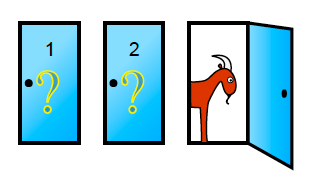
<p dir="ltr"><span>The power of PLP can also be illustrated by its ability of solving puzzles, such as the Monty Hall puzzle (</span><a href="http://cplint.ml.unife.it/example/inference/monty.swinb"><span>http://cplint.ml.unife.it/example/inference/monty.swinb</span></a><span>), the truel, or duel among three opponents (</span><a href="http://cplint.ml.unife.it/example/inference/truel.swinb"><span>http://cplint.ml.unife.it/example/inference/truel.swinb</span></a><span>), the coupon collector problem (</span><a href="http://cplint.ml.unife.it/example/inference/coupon.swinb"><span>http://cplint.ml.unife.it/example/inference/coupon.swinb</span></a><span>) or the three-prisoners puzzle (</span><a href="http://cplint.ml.unife.it/example/inference/jail.swinb"><span>http://cplint.ml.unife.it/example/inference/jail.swinb</span></a><span>). </span></p>
<p dir="ltr"><span>Humans have difficulty in providing the correct answer for these problems </span></p>
<p dir="ltr"><span>while PLP can compute the correct solution very quickly.</span></p>
</td>
</tr>
<tr>
<td><img src="https://old.dmi.unife.it/en/highlights/animation.gif" title="" height="179" width="227" alt="" class="image-inline" /><br /></td>
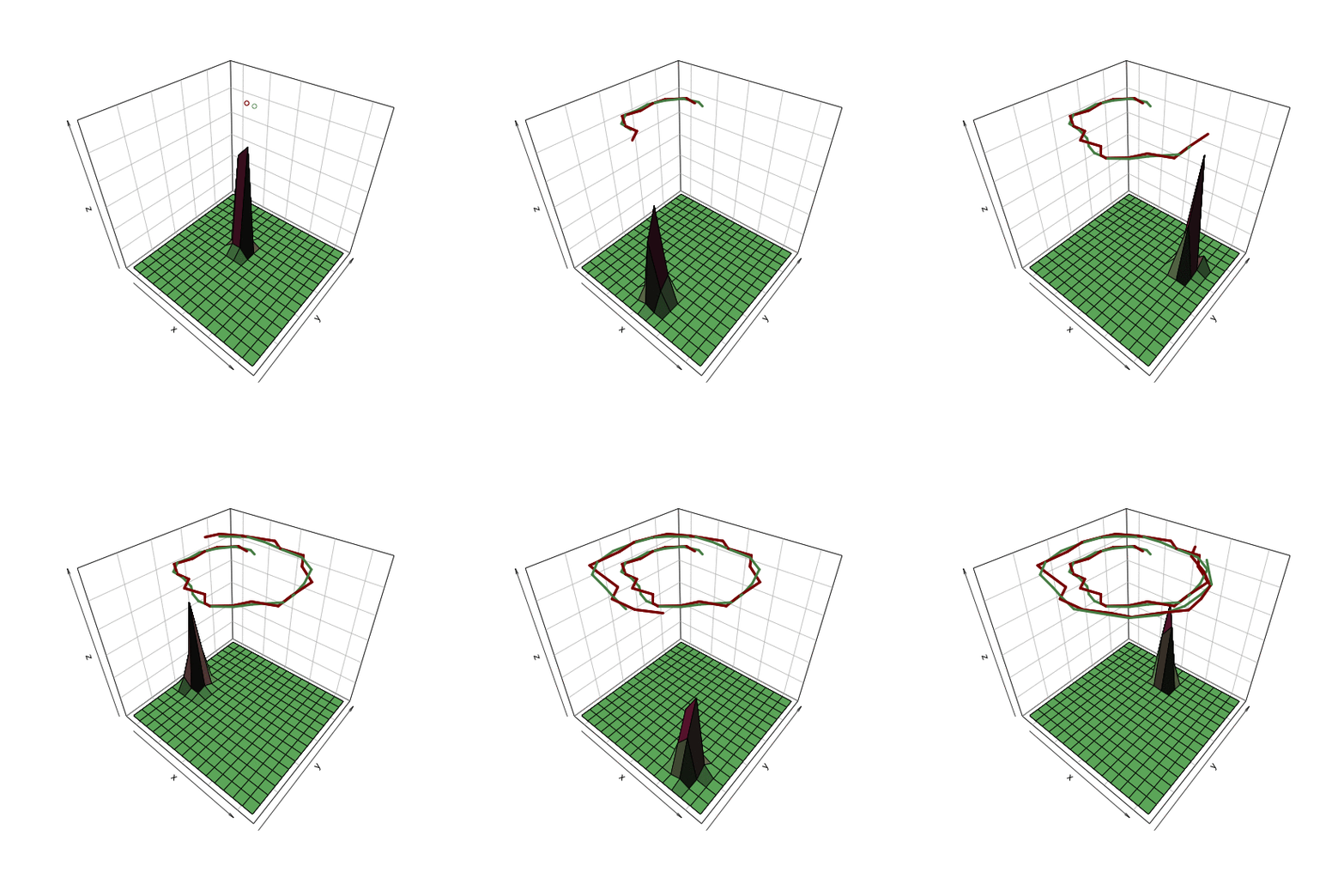
<td><span>PLP  can also be used for dealing with continuous random variables. The  picture on the left shows the probability distribution of the prediction  of the position of an object moving in 2 dimensions made using a Kalman  filter.</span></td>
</tr>
</tbody>
</table>
<p dir="ltr"><span>Publications:</span></p>
<ul>
<li dir="ltr" style="list-style-type:disc; ">
<p dir="ltr"><span>Fabrizio Riguzzi, Elena Bellodi, Evelina Lamma, Riccardo Zese, and Giuseppe Cota. Probabilistic logic programming on the web. </span><span>Software: Practice and Experience</span><span>, 46(10):1381-1396, © Wiley, October 2016. [ </span><a href="http://mcs.unife.it/~friguzzi/journals_bib.html#RigBelLam16-SPE-IJ"><span>bib</span></a><span> | </span><a href="http://dx.doi.org/10.1002/spe.2386"><span>DOI</span></a><span> | </span><a href="http://ds.ing.unife.it/~friguzzi/Papers/RigBelLam-SPE16.pdf"><span>.pdf</span></a><span> ]</span></p>
</li>
<li dir="ltr" style="list-style-type:disc; ">
<p dir="ltr"><span>Fabrizio Riguzzi. The distribution semantics for normal programs with function symbols. </span><span>International Journal of Approximate Reasoning</span><span>, 77:1 - 19, © Elsevier, October 2016. [ </span><a href="http://mcs.unife.it/~friguzzi/journals_bib.html#Rig16-IJAR-IJ"><span>bib</span></a><span> | </span><a href="http://dx.doi.org/10.1016/j.ijar.2016.05.005"><span>DOI</span></a><span> | </span><a href="http://ds.ing.unife.it/~friguzzi/Papers/Rig-IJAR16.pdf"><span>.pdf</span></a><span> | </span><a href="http://authors.elsevier.com/a/1TBE1,KD6ZCJ~x"><span>http</span></a><span> ]</span></p>
</li>
<li dir="ltr" style="list-style-type:disc; ">
<p dir="ltr"><span>Nicola Di Mauro, Elena Bellodi, and Fabrizio Riguzzi. Bandit-based Monte-Carlo structure learning of probabilistic logic programs. </span><span>Machine Learning</span><span>, 100(1):127-156, © Springer International Publishing, July 2015. The original publication is available at </span><a href="http://link.springer.com/"><span>http://link.springer.com</span></a><span>. [ </span><a href="http://mcs.unife.it/~friguzzi/journals_bib.html#DiMBelRig15-ML-IJ"><span>bib</span></a><span> | </span><a href="http://dx.doi.org/10.1007/s10994-015-5510-3"><span>DOI</span></a><span> | </span><a href="http://ds.ing.unife.it/~friguzzi/Papers/DiMBelRig-ML15.pdf"><span>.pdf</span></a><span> ]</span></p>
</li>
</ul>
<ul>
<li dir="ltr" style="list-style-type:disc; ">
<p dir="ltr"><span>Elena Bellodi and Fabrizio Riguzzi. Structure learning of probabilistic logic programs by searching the clause space. </span><span>Theory and Practice of Logic Programming</span><span>, 15(2):169-212, © Cambridge University Press, 2015. [ </span><a href="http://dx.doi.org/10.1017/S1471068413000689"><span>DOI</span></a><span> | </span><a href="http://arxiv.org/abs/1309.2080"><span>http</span></a><span> ]</span></p>
</li>
<li dir="ltr" style="list-style-type:disc; ">
<p dir="ltr"><span>Fabrizio Riguzzi and Terrance Swift. Well-definedness and efficient inference for probabilistic logic programming under the distribution semantics. </span><span>Theory and Practice of Logic Programming</span><span>, 13(Special Issue 02 - 25th Annual GULP Conference):279-302, © Cambridge University Press, March 2013. [ </span><a href="http://mcs.unife.it/~friguzzi/journals_bib.html#RigSwi13-TPLP-IJ"><span>bib</span></a><span> | </span><a href="http://dx.doi.org/10.1017/S1471068411000664"><span>DOI</span></a><span> | </span><a href="http://arxiv.org/pdf/1110.0631v1"><span>http</span></a><span> ]</span></p>
</li>
<li dir="ltr" style="list-style-type:disc; ">
<p dir="ltr"><span>Fabrizio Riguzzi and Terrance Swift. The PITA system: Tabling and answer subsumption for reasoning under uncertainty. </span><span>Theory and Practice of Logic Programming, 27th International Conference on Logic Programming (ICLP'11) Special Issue, Lexington, Kentucky 6-10 July 2011</span><span>, 11(4-5):433-449, © Cambridge University Press, 2011. [ </span><a href="http://dx.doi.org/10.1017/S147106841100010X"><span>DOI</span></a><span> </span><a href="http://arxiv.org/pdf/1107.4747v1"><span>http</span></a><span> ]</span></p>
</li>
</ul>
<p> </p>
<p dir="ltr"><span>Contact:</span></p>
<p dir="ltr"><span>Prof. Dr. Fabrizio Riguzzi </span></p>
<p dir="ltr"><span>Dipartimento di Matematica e Informatica, Università di Ferrara </span></p>
<p dir="ltr"><span>Blocco B, Polo Scientifico Tecnologico </span></p>
<p dir="ltr"><span>Via Saragat 1, 44122, Ferrara, Italy </span></p>
<p dir="ltr"><span>Tel: +39 0532 97 4792 </span><a href="http://mcs.unife.it/~friguzzi/"><span>Web</span></a><span> </span><a href="mailto:fabrizio.riguzzi@unife.it "><span>E-Mail</span></a></p>]]></content:encoded>
    <dc:publisher>No publisher</dc:publisher>
    <dc:creator>Ferrari Michele</dc:creator>
    <dc:rights></dc:rights>
    
      <dc:subject>highlights</dc:subject>
    
    <dc:date>2017-11-23T12:24:05Z</dc:date>
    <dc:type>News Item</dc:type>
  </item>


  <item rdf:about="https://old.dmi.unife.it/en/highlights/a-brief-history-of-mathematics-at-the-university-of-ferrara">
    <title>A brief history of Mathematics at the University of Ferrara</title>
    <link>https://old.dmi.unife.it/en/highlights/a-brief-history-of-mathematics-at-the-university-of-ferrara</link>
    <description>Mathematics has a strong tradition at the University of Ferrara which goes back to the foundation of the University in 1391. Focus here is on the early history of mathematics at University of Ferrara. Recent developments will only be mentioned marginally. (In Italian)</description>
    <content:encoded xmlns:content="http://purl.org/rss/1.0/modules/content/"><![CDATA[<table class="plain">
<tbody>
<tr>
<td>1391 - 1771</td>
<td>
<p><a class="external-link" href="http://dmi.unife.it/it/organizzazione/storia/resolveuid/1f17e5995bcd4d08b0bc6da6f271f244" target="_blank">The first Mathematical Teachings</a></p>
<p>(italian)</p>
</td>
</tr>
<tr>
<td>1802 - 1940</td>
<td>
<p><a class="external-link" href="http://dmi.unife.it/it/organizzazione/storia/resolveuid/33bb47653eba44d7acf3e15379de5c25" target="_blank">Mathematics in Ferrara in the nineteenth and early twentieth centuries<br /></a></p>
<p>(italian)</p>
</td>
</tr>
<tr>
<td>1945 - Modern Times<br /></td>
<td>
<p><a class="external-link" href="http://dmi.unife.it/it/organizzazione/storia/resolveuid/1e642f865e0d4d15861a9258a83826ff" target="_blank">Mathematics in the modern university</a></p>
<p>(italian)</p>
</td>
</tr>
<tr>
<td>1391 - Modern Times<br /></td>
<td>
<p><a class="external-link" href="http://dmi.unife.it/it/organizzazione/storia/resolveuid/80654dab2a9d4a848370536069f05af6" target="_blank">Historical Buildings of the Mathematical Teachings</a></p>
<p>(italian)</p>
</td>
</tr>
<tr>
<td>1936 - 1959</td>
<td>
<p><a class="external-link" href="http://dmi.unife.it/it/organizzazione/storia/resolveuid/ede087a70feb4a9fac03794b95fee622" target="_blank">Mathematics in Annali dell'Università di Ferrara</a></p>
<p>(italian)</p>
</td>
</tr>
</tbody>
</table>
<p> </p>
<p>Literature</p>
<ol>
<li>
<p align="justify">Alessandra Fiocca, Luigi Pepe, <i>La lettura di matematica nell'Università di Ferrara, dal 1602 al 1771</i>. Annali Un. Ferrara Sez. VII , <i>31</i> (1985), pp. 125-167.</p>
</li>
<li>
<p align="justify">Alessandra Fiocca, Luigi Pepe, <i>L'Università e le Scuole per gli Ingegneri a Ferrara</i>. Annali Univ. Ferrara Sez. VII, <i>32</i> (1986), pp. 125-166.</p>
</li>
<li>
<p align="justify">Alessandra Fiocca, Luigi Pepe<i> L'insegnamento della matematica nell'Università di Ferrara dal 1771 al 1942</i>, in <i>Università e cultura a Ferrara e Bologna</i>, Firenze, Olschki, 1989, pp. 1-79.</p>
</li>
<li>
<p align="justify">Maria Teresa Borgato, Luigi Pepe<i>, La matematica nella prima serie degli Annali dell’Università di Ferrara: due lavori di M. Beloch e W. Gröbner</i>, Ferrara, Tip. Litografia Artigiana, 1997.</p>
</li>
</ol>
<p> </p>
<p>A special thank you goes to Prof. Luigi Pepe for his support in compiling the history of the Department.</p>]]></content:encoded>
    <dc:publisher>No publisher</dc:publisher>
    <dc:creator>Ferrari Michele</dc:creator>
    <dc:rights></dc:rights>
    
      <dc:subject>highlights</dc:subject>
    
    <dc:date>2017-08-04T21:58:49Z</dc:date>
    <dc:type>News Item</dc:type>
  </item>


</rdf:RDF>